India is the world’s largest exporter of basmati rice, shipping over 6 million metric tons in FY 2024-25 to markets across the Gulf, Europe, and North America. The supply is vast. The range of suppliers behind that supply is even more so, from integrated mill owners who have been in the trade for decades to opportunistic traders who entered the market when prices were good and sourced wherever stock was available. For a procurement manager or wholesale buyer, the challenge is knowing which is which before the purchase order goes out.
Most buyers who have been through a bad shipment describe the same pattern. The quote was competitive. The supplier seemed professional. The certificates arrived. Then the grain was shorter than specified, or the moisture was wrong, or the phytosanitary certificate had the wrong codes for the destination port and the container sat for ten days. The paperwork gap between what was promised and what arrived is where most sourcing problems in this trade originate.
At Barkat Rice, we have been manufacturing and exporting 1121 Basmati from Surat, Gujarat since 2001, with our parent company Deepak Overseas operating in the rice trade since 1989. Over thirty-five years in this industry, we have seen enough of these situations to know exactly where they come from and how to prevent them. This guide covers what experienced buyers verify before any shipment leaves India, and why each of those checks matters.
The First Question Buyers Get Wrong
Price comparisons happen before quality verification more often than they should. A buyer receives three quotes for 1121 Sella Basmati rice, all describing the same product, and starts negotiating from the lowest number. The problem is that “1121 Sella” on a quotation sheet describes a variety and a processing method. It says nothing about grain length, moisture content, broken grain percentage, or how long the rice has been aged. Two shipments can both be accurately labeled 1121 Sella and perform completely differently in the kitchen.
Get the specification sheet before the price discussion. A supplier who resists putting grain parameters in writing before the commercial invoice is telling you something.
Manufacturer vs. Trader: The Distinction That Changes Everything
Rice exporting companies in India operate across a wide range. At one end are integrated manufacturer-exporters who own their milling facility, source paddy directly from farms, control aging, and export finished rice under their own brand. At the other end are trading firms that buy finished stock from mills on the spot market, rebox it, and sell it on.
Neither type is automatically unreliable, but the risks are different and worth understanding before you commit to a volume order.
A manufacturer-exporter can tell you the paddy origin for the batch you are buying, the milling date, the aging period, and the grain parameters tested at their own or a third-party laboratory. If a quality issue comes up, they have records. They also have skin in the game: their brand travels with every bag.
A trader cannot give you that level of traceability because they did not control those stages. The mill that supplied their last order may or may not be the mill supplying the next one. That is how batches drift in quality even when the paperwork says nothing changed.
The question to ask directly is: do you own the milling facility? A manufacturer answers that in one sentence and offers evidence. A trader uses phrases like “we work with a network of trusted production partners.”
Certifications: What Is Mandatory and What Actually Differentiates
Every legitimate basmati rice exporter operating from India needs APEDA registration and must obtain a Registration-cum-Allocation Certificate before shipping. They also need an FSSAI license and a Phytosanitary Certificate for each shipment, issued by the Directorate of Plant Protection, Quarantine and Storage, confirming the rice is free from pests and plant disease.
These are the legal minimums. Thousands of exporters hold them. Asking for APEDA and FSSAI documents is table stakes, not due diligence.
What actually differentiates suppliers is third-party lab testing. SGS, Bureau Veritas, and Intertek are the names worth recognizing. When an independent laboratory with no financial interest in your shipment has tested and signed off on the grain parameters, that report carries weight. In-house testing is better than no testing, but it should accompany rather than replace third-party certification for first orders or large volumes.
For buyers shipping into Saudi Arabia, one additional requirement applies: exporters must demonstrate compliance with ISO 22000 or HACCP food safety management standards. This has been mandatory since 2019 and applies to the exporting establishment, not just the product. Verify this before contracting for Saudi-bound shipments rather than discovering it during customs clearance.
What 1121 Sella Basmati Actually Means — and Why Buyers Need to Know
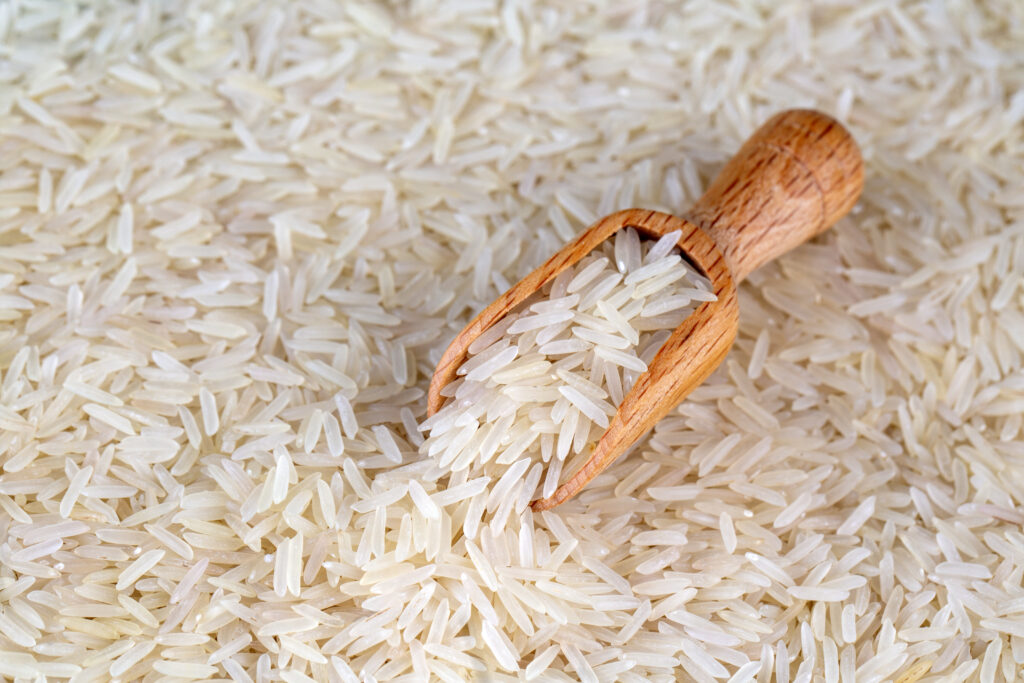
1121 is the paddy variety. It was developed by the Indian Agricultural Research Institute and became the dominant premium export variety because of its extra-long grain and high elongation ratio after cooking. When properly prepared, the grain can more than double in length, which is why it is the variety of choice for biryani, pilaf, and HoReCa applications across the Gulf.
Sella means parboiled. The paddy is partially boiled before milling, which gelatinizes the starch and makes the grain resistant to breakage during both milling and cooking. This matters in high-volume professional kitchens where rice sits in a bain-marie or gets reheated. Sella holds its structure. Raw or steam basmati is more fragrant but less forgiving.
Steam Basmati (sometimes called white basmati) is processed differently. The grain is softer, the aroma is more pronounced, and the texture is closer to what consumers expect from restaurant-quality basmati at home. It is better suited for premium retail or restaurant applications where the rice is cooked to order and served immediately.
Buyers specifying the wrong type for their end use is a common and avoidable problem. A wholesale buyer supplying a catering company should default to Sella. A buyer supplying premium grocery retail should be looking at steam basmati and specifying aroma level explicitly.
Aging: The Parameter Most Specification Sheets Omit
Freshly milled basmati has higher moisture content and tends to become sticky when cooked in volume. Aged basmati, typically stored for twelve months or more before sale, has lower moisture, elongates more consistently, and produces the separate-grain result that professional kitchens expect.
Aging is measured from the milling date, not from the harvest season. Rice milled from paddy stored two seasons ago is genuinely aged. Rice milled six months ago from the same season’s paddy is fresh. Both can be sold as “basmati” without specifying aging, and buyers who do not ask will occasionally receive fresh rice on orders where they expected aged.
Put minimum aging in the purchase agreement. Ask for the milling date on the specific batch being shipped. An exporter who cannot provide this information either sources from the spot market without tracking batch history or does not consider it relevant. Both answers should affect how much of your first order you are willing to risk.
Documentation: What a Clean Shipment Looks Like on Paper
A well-documented shipment from a reliable Indian basmati rice exporter arrives with a commercial invoice, packing list, bill of lading, certificate of origin, phytosanitary certificate, APEDA-issued RCAC, and a quality certificate confirming the batch parameters.
Buyers should request documentation from the supplier’s last two or three shipments to their destination country before placing the first order. This tells you whether the paperwork is consistently in order or whether it gets assembled under pressure when a shipment is already at port.
Shipments to the EU require a Certificate of Inspection from an Export Inspection Council or Export Inspection Agency in addition to the above. Shipments to Russia require pre-shipment quality certification from an APEDA-authorized laboratory. Get clarity on destination-specific requirements before the order is confirmed, not after.
Packaging Specifications Place after: “Documentation: What a Clean Shipment Looks Like on Paper”
Packaging Options and What to Specify in Your Order
Buyers often treat packaging as an afterthought. For wholesale and distribution buyers, the wrong pack size or bag material creates downstream problems in warehousing and retail. Here is what to specify upfront:
Standard export bag types:
- 25kg PP (polypropylene) woven bags: most common for bulk wholesale and HoReCa supply
- 50kg PP bags: used for large-volume institutional buyers; less common for retail-facing distribution
- Jute bags: preferred for certain premium or specialty markets that require natural packaging
- 5kg and 10kg branded retail bags: for importers distributing into supermarket or grocery chains
What to confirm before the order is placed:
- Bag material: PP woven, non-woven, jute, or BOPP (biaxially-oriented polypropylene for printed retail packs)
- Bag weight: 5kg, 10kg, 25kg, or 50kg
- Inner liner: whether a moisture-resistant inner bag is included, relevant for humid destination markets
- Label information: variety name, country of origin, net weight, production date, and expiry date in the language required by your destination market
- Palletization: whether the container is loaded palletized or floor-loaded, which affects unloading time and damage rates at destination
One thing buyers miss: if you are reselling into UAE retail, labels must carry information in both English and Arabic. Confirm this with your supplier before production begins, not when the container arrives.
Pre-Shipment Inspection: Build It Into the Contract
Buyers should include a pre-shipment inspection clause in the purchase agreement as standard practice, not as an exception for large or first-time orders. Independent inspectors verify grain parameters, moisture levels, packaging integrity, and loading condition before the container is sealed.
A genuine 1121 Sella Basmati rice manufacturer welcomes pre-shipment inspection because it protects them as much as it protects you. A supplier who pushes back on this clause has either had problems with third-party verification before or has something to verify. Either way, that response is worth noting.
If cost is a concern, the pre-shipment inspection fee for a standard container shipment is a fraction of the cost of a rejected or substandard delivery.
Payment Terms and What They Signal
Standard terms in Indian basmati export trade run to Letter of Credit, Telegraphic Transfer with advance, and Documents Against Payment. Indian export regulations restrict basmati rice shipments on Document Against Acceptance terms unless covered by Bank Guarantee or ECGC Guarantee.
An exporter offering D/A terms without that coverage has either a compliance gap or is trying to close the deal faster than the documentation allows. Either situation is worth flagging.
For a first-time buyer, thirty to fifty percent advance payment or an LC is a reasonable expectation. An exporter willing to ship significant volume to a new buyer with no security at all is not being generous. They are either managing cash flow poorly or prioritizing order volume over business fundamentals. Both are risks that show up later.
Red Flags Worth Knowing Before You Start Negotiating
Lead times shorter than seven days for large in-specification orders suggest the supplier is holding pre-packed stock of uncertain age, or they are quoting a timeline they intend to revise after the purchase order arrives.
Grain parameters that appear only on the quotation but disappear from the purchase agreement should be put back in writing. If a supplier declines to commit to specification in the contract, they are leaving themselves room to ship off-specification without liability.
Suppliers who cannot name their paddy sourcing region are either sourcing from outside the traditional basmati belt, primarily Haryana, Punjab, Uttar Pradesh, and Uttarakhand, or buying from aggregators without traceability. Grain grown outside these regions is legal and may be good quality, but buyers paying premium prices for traditional-belt basmati should be able to confirm origin.
A quote that is substantially below market rate for the grade specified almost always reflects a difference in actual grade, aging status, or broken grain percentage. The basmati market is well-traded and pricing is reasonably transparent. Significant gaps below market are a signal to investigate before they are a reason to proceed.
Why We Started With What Goes Wrong
We manufacture our rice in-house and export under the Barkat brand. Every bag that leaves our facility carries our name on it. We do not offer private label. That decision is deliberate. It keeps us accountable to the standard our brand represents across every market we supply, and it means buyers always know exactly what they are getting and where it came from.
Our 1121 Sella Basmati range runs across four variants: Magic, Super, Krishma, and Gold, each covering a different quality tier within the Sella category. Our 1121 Steam Basmati covers Mahek and Sadabahar, for buyers supplying premium retail or restaurant contexts where aroma and texture take priority over cooking resilience. All variants are processed in-house and shipped under the Barkat label.
We supply across 5 export markets with more than 100 distributor partners globally. Buyers in the Gulf and UAE ask the same questions this guide covers: grain parameters in writing, third-party lab reports, and a supplier who responds when something needs clarification. That is what we are set up to provide.
If you are evaluating suppliers for a basmati rice import program, download the Barkat product brochure or contact us directly at barkatrice.in/contact-us.
One Order vs a Supply Relationship — What Changes After the First Shipment
Most buyers approach the first order as a trial. That is correct. What experienced importers do differently is structure that trial with the next order in mind. A supplier who knows you are evaluating a long-term relationship behaves differently from one who believes they are closing a single transaction.
What to establish on the first order that protects you on the second:
- Retain a sealed sample of the approved rice from the first shipment. If grain parameters drift on subsequent orders, the retained sample is your reference point
- Agree on a reorder price mechanism upfront. FOB price is tied to crop season and freight rates. A supplier willing to discuss how pricing adjusts between orders is more transparent than one who simply requotes each time
- Specify batch continuity: for repeat orders, confirm you expect the same mill, same aging lot, and same grain parameters unless otherwise agreed in writing
- Ask about supply capacity during peak demand periods. Eid and Ramadan create demand spikes across Gulf markets. An exporter who cannot confirm availability 60 days in advance during these periods will either disappoint you or overprice you at the last moment
What a good long-term supplier relationship looks like in practice:
- Proactive updates on crop season quality and pricing movement before you ask
- Consistent documentation turnaround, not just on the first order
- Direct access to someone who knows your account, not a rotating sales contact
- Willingness to hold allocated stock for confirmed repeat buyers during tight supply periods
The Verification Sequence Before Any First Order
Before committing to any Indian basmati rice exporter, run through this sequence in order. Reliable suppliers answer every point without hesitation. The ones who deflect or provide vague responses to any of the below are showing you something worth paying attention to before you have transferred a rupee.
- Verify the APEDA RCMC number on the APEDA portal. This takes two minutes and confirms the exporter is legally registered to ship
- Request the phytosanitary certificate and quality certificate from the supplier’s last two shipments to your destination country
- Get grain parameters in writing: length, moisture percentage, broken grain percentage, elongation ratio, and milling date for the specific batch being offered
- Confirm whether they own the milling facility, something a manufacturer answers immediately; a trader reaches for softer language
- Request third-party lab reports from SGS, Bureau Veritas, or Intertek for the grade being quoted
- Include a pre-shipment inspection clause in the purchase agreement before signing
- Confirm payment terms and lead time commitments in the contract, not in a WhatsApp message
Frequently Asked Questions About Sourcing Basmati Rice from India
These are the questions buyers ask most often when evaluating Indian basmati rice exporters for the first time. Answers are based on current trade practice and APEDA guidelines.
Which country is the largest exporter of basmati rice?
India, by a significant margin. India supplies over 70% of global basmati rice exports and ships to more than 140 countries. Saudi Arabia, UAE, Iraq, Iran, and the US are the five largest buying markets by volume.
What is the difference between 1121 Sella and Steam Basmati rice?
- Sella is parboiled before milling. The grain is firmer, resistant to breakage, and holds its shape through reheating and bulk cooking
- Steam basmati is processed with steam only, without full parboiling. It is softer, more aromatic, and better for premium retail and restaurant use where rice is cooked fresh to order
- For wholesale supply to hotels, caterers, and food distributors in the Gulf, Sella is the standard choice
How do I know if an Indian basmati rice exporter is genuine?
- Verify their APEDA RCMC number on the APEDA portal. It is publicly searchable
- Ask for their DGFT-issued Importer Exporter Code
- Request the phytosanitary certificate and bill of lading from their last two shipments to your region
- A genuine manufacturer-exporter produces all of this within 24 hours. Extended delays or vague responses are a pattern worth noting
What is the minimum order quantity for basmati rice from India?
- One FCL (Full Container Load) is the floor for most established exporters
- A 20-foot container holds 20 to 25 MT depending on bag size and packing material
- Some exporters consolidate LCL shipments but this adds freight cost and documentation complexity
How long does shipping from India to Dubai take?
- Sea transit from Mundra or Nhava Sheva to Jebel Ali: 7 to 12 days
- Order confirmation to container loading for in-stock orders: 5 to 10 days
- Realistic total lead time from purchase order to Jebel Ali arrival: 3 to 4 weeks for a first order
What documents do I need to import basmati rice from India?
- Commercial invoice and packing list
- Bill of lading
- Certificate of origin
- Phytosanitary certificate issued by DPPQS
- APEDA-issued RCAC
- Quality or lab certificate confirming batch parameters
- For Saudi Arabia: ISO 22000 or HACCP compliance certificate from the exporting establishment
- For EU: Certificate of Inspection from an Export Inspection Council or Agency
Is 1121 Sella rice good for biryani?
Yes. It is the dominant variety used for biryani in professional kitchens across the Gulf precisely because the parboiled grain elongates well, stays separate, and holds structure through the dum cooking process. Sella absorbs spice and moisture without turning mushy, which is why caterers and hotel kitchens specify it over steam or raw basmati for large-batch cooking.